
 By
By 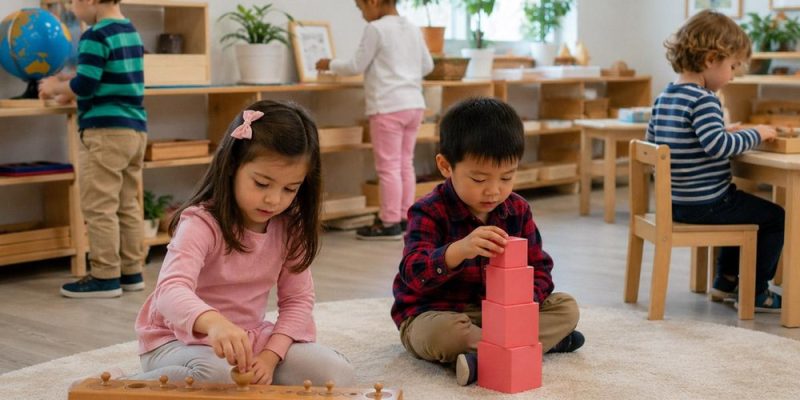
Exploring how hands-on Montessori materials help children build independence, concentration, confidence, and more profound understanding.
Walk into a Montessori classroom and one of the first things you notice is that it feels different from a traditional learning environment. Instead of rows of desks and constant teacher-led instruction, you see children actively engaged with carefully designed learning materials. Some are working independently with counting beads; others are tracing sandpaper letters, pouring water between containers, or building geometric shapes with quiet concentration. Every material has a purpose, and every activity is intentionally designed to support how children naturally learn.
Montessori materials are not random classroom toys. They are structured educational tools created to help children understand abstract concepts through direct, hands-on experiences. Rather than memorizing information passively, children physically interact with lessons in ways that strengthen comprehension, focus, problem-solving skills, and independence.
At KV Montessori, Montessori materials are integrated into daily learning experiences that encourage children to become active participants in their education while developing confidence and curiosity along the way.
“Montessori materials are designed to help children learn by doing, not simply by watching or memorizing.”
Why Hands-On Learning Matters in Early Childhood
Young children naturally learn through movement, repetition, observation, and sensory experiences. Traditional lecture-style instruction often asks children to absorb concepts before they are developmentally ready to fully understand them. Montessori education approaches learning differently by recognizing that children build knowledge most effectively when they can physically engage with ideas.
For example, instead of only hearing about numbers, children use bead chains and counting rods to see and feel numerical relationships. Instead of simply memorizing letters visually, they trace textured sandpaper letters with their fingers while simultaneously hearing sounds spoken aloud. These multisensory experiences strengthen neural connections and help children retain information more naturally.
Hands-on learning also keeps children actively involved in the educational process. Rather than becoming passive listeners, students develop concentration by interacting directly with materials that require attention, coordination, and problem-solving.
This approach often reduces frustration because children can work at their pace and repeat activities until they feel comfortable moving forward. Mastery becomes driven by understanding instead of pressure.
Montessori Materials Encourage Independent Thinking
One of the defining characteristics of Montessori materials is that they are intentionally designed to promote independence. Children are encouraged to select activities, complete them independently, recognize mistakes, and self-correct whenever possible.
Many Montessori materials include built-in “control of error” systems. This means the child can often identify mistakes without immediate adult correction. For example, puzzle pieces only fit correctly one way, counting materials reveal inconsistencies visually, and practical life exercises naturally show when a task has not been completed properly.
This self-correcting process is extremely valuable because it shifts the learning experience away from fear of failure and toward problem-solving. Children begin developing resilience, patience, and confidence as they discover they are capable of figuring things out independently.
Instead of relying on constant external validation, students develop internal motivation and a sense of ownership over their learning process.
At KV Montessori, classrooms are structured to encourage children to explore, repeat, and master skills with increasing independence over time.
The Role of Sensory Learning in Montessori Education
Montessori education strongly emphasizes sensory exploration because young children absorb information through their senses long before abstract reasoning fully develops.
Many Montessori materials isolate one specific concept or sensory experience at a time. For example, color tablets focus purely on visual color recognition, while sound cylinders help children distinguish differences in volume and tone. Textured materials refine touch sensitivity, and geometric solids introduce spatial awareness through direct handling.
This careful isolation of concepts helps children process information more clearly without becoming overwhelmed. Sensory learning also creates stronger cognitive associations because children are engaging multiple parts of the brain simultaneously.
Research consistently shows that multi-sensory learning can improve memory retention, engagement, and overall comprehension. Montessori classrooms naturally support this process through purposeful material design.
The physical manipulation of materials also strengthens fine motor skills, hand-eye coordination, and concentration, all of which support broader academic development later on.
“Children often understand complex ideas more deeply when they can physically experience them first.”
How Montessori Materials Support Long-Term Academic Growth
One of the reasons Montessori materials are so effective is that they introduce foundational concepts in a concrete way before gradually moving toward abstract thinking.
Mathematics is a strong example. Instead of immediately introducing worksheets and memorization, children first work with tangible quantities using beads, rods, and number systems they can physically manipulate. This creates a deeper conceptual understanding before abstract symbols and equations are introduced.
Language development follows a similar progression. Children often build phonetic awareness through tactile and auditory experiences before transitioning into reading and writing fluency.
Because students truly understand the “why” behind concepts rather than simply memorizing procedures, they often develop stronger critical thinking skills and greater academic confidence over time.
Montessori materials also encourage concentration through uninterrupted work periods. Children practice sustained attention naturally while engaging in meaningful tasks they have chosen independently.
These skills extend far beyond academics. Patience, organization, self-discipline, and persistence all become part of the child’s broader developmental growth.
Why Montessori Materials Continue to Evolve With the Child
Another strength of Montessori education is that the materials grow progressively more advanced as children develop. Early practical life activities build coordination and focus, while later lessons introduce increasingly sophisticated academic concepts.
Because the learning progression is carefully structured, children build upon previously mastered skills in a logical sequence. This creates continuity and confidence throughout their educational journey.
Montessori classrooms are intentionally designed to support individualized learning. Children are not forced to move at the same pace as an entire group. Instead, they progress according to readiness and mastery.
This individualized approach often allows children to develop stronger self-esteem because learning becomes less about comparison and more about personal growth.
FAQs
Are Montessori materials just educational toys?
No. Montessori materials are intentionally designed learning tools that follow specific educational principles and developmental goals.
Why are Montessori materials hands-on?
Hands-on learning helps children engage multiple senses, improving understanding, concentration, and long-term retention.
Do Montessori materials help with independence?
Yes. Many materials are self-correcting, allowing children to identify mistakes and solve problems independently.
Can Montessori methods prepare children for traditional academics?
Absolutely. Montessori education builds strong foundational skills in reading, math, concentration, and critical thinking.
Schedule a Tour at KV Montessori
Families looking for a learning environment that encourages independence, curiosity, and hands-on exploration can discover the benefits of Montessori education at KV Montessori. Through thoughtfully designed Montessori materials and child-centered instruction, students develop both academic confidence and important life skills that support long-term success. Schedule a tour today to learn more about the Montessori difference.









Comments